So my Intro to the Read/Write Web students begin blogging this week, and as The Nerdy Teacher suggested in a post on Edutopia, I'm going to pick my blog back up to serve as a model for my students. As I considered this reentry to the blogging community, I thought I would take the advantage this time to document my work in "Flipping" my Algebra I course for this school year with a series of posts about my experience. Hopefully my students will take something away from reading my posts, but what would make me even happier is if someone reading this finds my experiences useful. Of course I would love to hear comments from any new followers I might pick up to help me hone my skills in this new venture.
As an introduction to where I stand, I began incorporating lessons and practice modules from Khan Academy into my Algebra I course last year since I had been moved into a computer lab to teach. The use of these resources gradually grew to be more of a part of the everyday class as the year progressed, so I took the next step for this year and decided to fully flip my class. I spent some time over the summer organizing the course, and already have made some major changes after only a month in the classroom. I'll talk in more detail about these, along with what seems to be working (and not working), and all of the further changes that are sure to come around, later on.
These posts will be mirrored on the site I use to teach my Intro to the Read/Write Web course in Weebly where my students will be able to view them and leave their comments, but I look forward to any professional comments on this site so please comment away. I'm also going to try to stick to the assigned theme I give to my students each week, so I apologize ahead of time for any scattered thoughts.
I'm really excited to be blogging again looking forward to documenting this experiment in flipping my classroom. Thanks for reading, and please feel free to share.
Tuesday, September 25, 2012


Sunday, March 11, 2012
Follow-up
After my last post, I thought I should follow up a bit. I sent my last post to my principal, and it started a much needed discussion/debate. To set-up his response, he's very hard line against social networking and mobile devices in school. I've spoken with him at every opportunity about the need and benefit of using these resources in school, and we've developed an ongoing, fun argument about it. I get where he's coming from, to a point, and he definitely has the best interests of his student body and their education in mind. He has allowed students in my classes to use their mobile devices while they are in my classroom, and I see this as a compliment to my teaching ability since it is so far out of his comfort zone.
My principal quickly shot back at me last week that we should have a debate about it, and while he was confident that I would oversee the use of social networks adequately and teach students to use them appropriately, he couldn't say the same for every other teacher. I understand this, and this led to the bigger problem behind the problem that leads to the outright ban of these sites: network rights. My side of the debate brought up the fact that Chemistry teachers frequently use hydrochloric acid in their classes, even though it can be very dangerous. But, because those teachers are qualified to oversee its use, we allow it because it is in the best interests of our students' education. The problem is that hydrochloric acid is really easy to keep in the chemical locker while network rights to access Facebook, Twitter, etc. isn't currently easy to keep locked up in the computer lab. As our network stands now, they are either accessible from our entire network or none of our network.
Grumble, grumble, debate more, grumble, grumble.
However far away the prospect of having the ability to teach my students what they really need to know may be, at least I can keep it front and center by continuing to bring it up and keep it in the conversation. And, we know what we need to look at as a school; who knows, maybe sometime soon on our network, it will be possible to make certain machines in our building have different filter restrictions than others. Let's make it a priority to find a way to allow the use of these "volatile chemicals"while still being able to keep them in the "social network chemical locker."
Wednesday, March 7, 2012
Social Networking: Come on Schools
Recently I decided, after hearing complaints from board members and parents, to browse around Twitter and see what my students were up to. Holy cow; was I ever disappointed! To set things up, a little background. I do not have a Facebook account; I've never seen any need for it. I do use Twitter, however, and I follow some friends and use it to keep up with news and posts about education and technology. I don't post much, and I use it mostly for entertainment rather than business. Since Twitter has exploded in popularity recently among our students, I decided to spend some time browsing around.
At first I was extremely disgusted with my students because of what I found. I found more inappropriate language than I could have imagined, Jr. High students posting personal/objectionable information, sisters telling each other not to share with parents that they have these accounts, mentions of drug use, profanity, etc. Simply appalling. Thoughts running through my head varied from, "I should email screenshots to parents" to "Did these students not hear anything I said about internet safety" to "Don't these students realize that any future employer is going to be heading straight to what I was looking at upon application for a position and decide quickly not to hire them?"
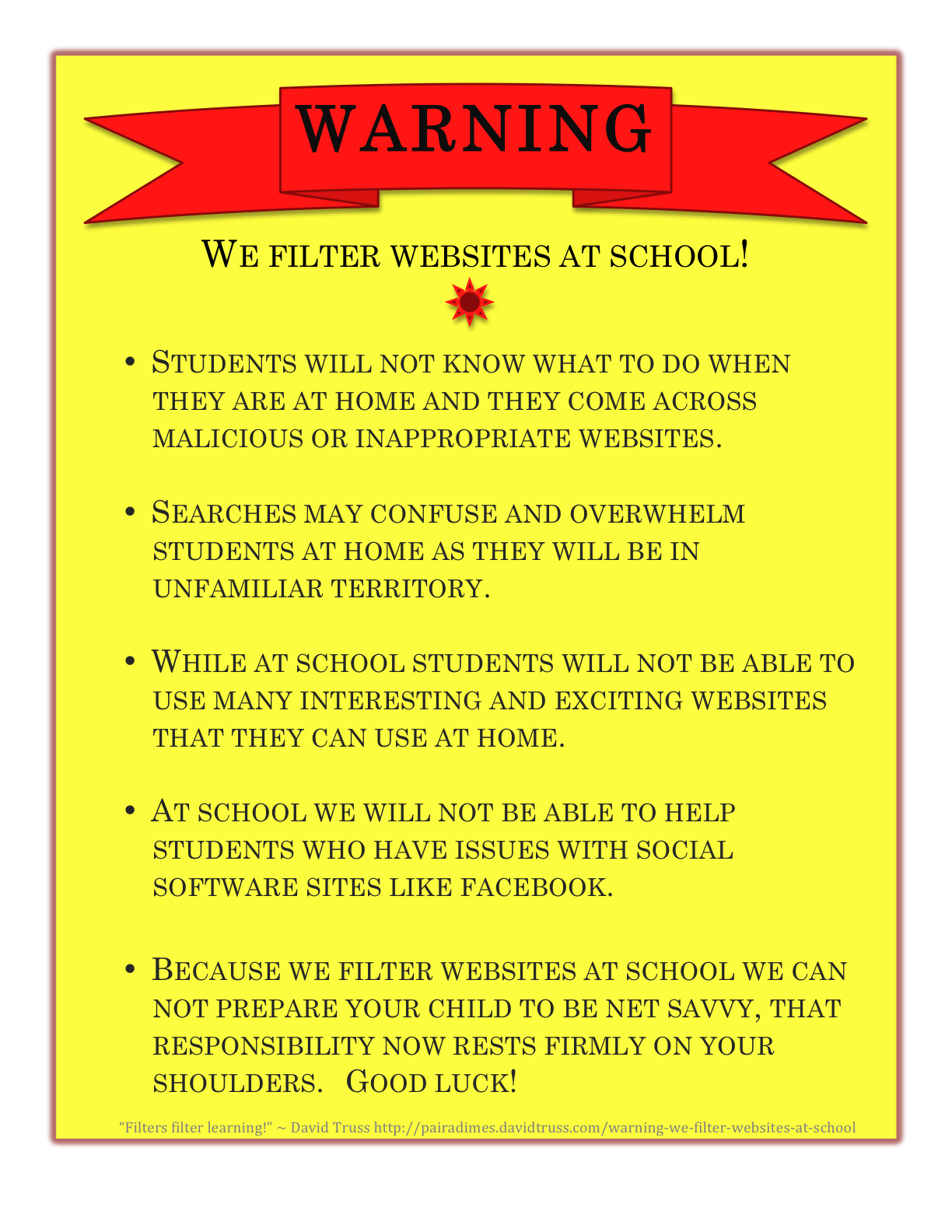
But fairly quickly my disgust shifted from these students to what we do as a school... All social networks are flat out blocked and disallowed during the school day. A while back, Scott McLeod posted a reference to this poster on his Mind Dump directed at this problem exactly. It comes from David Truss, who also writes excellent analogies out of frustration with this same issue.
I quickly came to this analogy: Social networking is like a jar full of candy.
What we do now, even in school, is teach students the benefits of eating healthy. We allow them to eat real candy, but we teach them how to do it appropriately and in moderation. We don't confiscate every Dum Dum that comes through our doors, but rather, we often use candy as a reward. We teach them about the dangers of tooth decay and ways to avoid it. We teach them about obesity and diabetes and their link to sugary foods. Sure, candy can be bad for you, but we educate on the appropriate use of candy in order to avoid these issues. It's called Health class.
On the other hand, with the Social Networking Candy Jar, we have shown it to students but repeatedly told them "No, you can't have ANY." We keep that jar of candy just out of reach of students and pretend it isn't there (but students know it is). We ignore it to the point that we don't even educate students on the benefits and dangers of it. So, as soon as we are out of sight, students are digging into this Social Networking Candy Jar. They're eating until their stomach aches and their teeth are falling out. They don't know that this will affect their future. And even though we know students are are doing this, we just pretend they aren't and continue ignoring the problem and standing by our line of "Don't eat the candy."
Come on schools, get with it. Broad internet filters and banning of Social Networking altogether isn't working. Our students are involved with it. The least we could do is educate them.
Image: David Truss, "Warning - We Filter Websites At School!" March 5, 2010 via Flickr, CC BY NC SA
Friday, September 2, 2011
Where does it go?
This morning in the car I was having a conversation with my three and a half year old daughter in which she said she was learning something. I promptly asked her if she liked learning, and she enthusiastically replied, "Yeah! I love learning; it's my favorite." As a teacher, I was very proud to hear this from her, but then I got to thinking about some of the students that have passed through my classroom and the ones I will be teaching this year and wondering how few of them would have replied in the positive with the same enthusiasm as my daughter. I'm guessing not too many of my secondary students!
Where have we gone wrong as a society and a system that we have taken this innate curiosity and love of learning and quashed it into a chore or something that our students resent? We are born with a natural desire to understand and learn, especially for those of us subscribing to the Piaget/Vygotsky Constuctivist ideals; what a shame that it is the exception among many secondary students to observe. It's not hard to point out some reasons for this (broken grading systems and policies, poor instructional strategies, sit-and-get learning, lack of choices, high-stakes testing, etc.).
But, what are we doing about it? We are very quick as schools to investigate the magic pill that will increase student achievement and test results because of poor performance by focusing on standards and teaching to tests and changing this and that in our system, etc. etc. etc. But I have never heard in all of my PD hours a mention of restoring this innate love of learning that I have witnessed in my own (and others') three year old child.
As the new school year rolls out, why don't we take a moment (or more) to forgo state standards (gasp!) and teach something that your students might find interesting or that may remind them of how enjoyable they once found learning? Not school, but LEARNING! Maybe you could be the spark that reignites this passion in one of your students!
Where have we gone wrong as a society and a system that we have taken this innate curiosity and love of learning and quashed it into a chore or something that our students resent? We are born with a natural desire to understand and learn, especially for those of us subscribing to the Piaget/Vygotsky Constuctivist ideals; what a shame that it is the exception among many secondary students to observe. It's not hard to point out some reasons for this (broken grading systems and policies, poor instructional strategies, sit-and-get learning, lack of choices, high-stakes testing, etc.).
But, what are we doing about it? We are very quick as schools to investigate the magic pill that will increase student achievement and test results because of poor performance by focusing on standards and teaching to tests and changing this and that in our system, etc. etc. etc. But I have never heard in all of my PD hours a mention of restoring this innate love of learning that I have witnessed in my own (and others') three year old child.
As the new school year rolls out, why don't we take a moment (or more) to forgo state standards (gasp!) and teach something that your students might find interesting or that may remind them of how enjoyable they once found learning? Not school, but LEARNING! Maybe you could be the spark that reignites this passion in one of your students!
Wednesday, July 13, 2011
An Interesting Dichotomy
I know it's been awhile, but it's been a busy summer so far. This summer I have been given an exciting and busy change of assignment for the upcoming school year, as mentioned in previous posts, that I am beginning to think about more and more as I work on the task at hand. In the upcoming school year I will change roles from a math teacher to a technology teacher, and this change has got me thinking about this job from a different perspective.
At the beginning of the summer I was told about this switch and my principal told me I would have free run in writing these courses as our retiring tech teacher was more of a business teacher than strictly a computers teacher, and the classes that I would be teaching didn't currently exist in our academic program. He just needs course titles, a description, and a syllabus to present to the superintendent and board. On one hand, I was very excited to have the freedom to develop my own courses and teach a curriculum that I deem appropriate. I mean, it's every teacher's dream, right? To have the ability to teach what I choose in a class not tested under NCLB, where students will actually learn and take something away from.
Throughout this work, however, I have begun to think about the implications of this. The freedom that is so refreshing to have does come with a cost. In a bigger district, this job would be the responsibility of a curriculum director, and I would be given a curriculum to work from, adjust, and implement. When it comes down to it, I am a teacher, not a curriculum director. I am confident that I will put forth a fine curriculum, that is not my concern. My concern is what sort of precedent is being set by my work. As we negotiate a contract during this time when, as with many other teachers, we are being asked to do more and more for less and less, I am concerned about where this precedent will lead. Yes, part of it is a bit of selfishness in which I would like to have some compensation for this non-contracted I am doing, but I know I have to do it because I am a teacher, and we teachers can't half-ass things when we are asked to do them and know that they are in the best interests of our students. Most of it is concern about the district's policy for the school and for the students. My concern is, where would the district be left if I were to take another position or not return for the upcoming school year? They would be hiring a cheap, young teacher in August to walk into a room full of computers and tell that person to teach a non-existent curriculum. How many of our first teaching assignments have started that way!?
In the grand scheme of things it comes down to our lack of value for education. We are in this position because schools lack the proper funding to fill positions like curriculum directors, technology directors, arts instructors, and in many cases the appropriate number of teachers. Contracts all over the State of Michigan are changing language to raise the per pupil ratio in order to lay off teachers while still being in compliance with labor agreements, and remaining teachers are being asked to do work that is beyond their job descriptions. Yes, we will do the work because we are morally obligated to do it, but where will this lead? The only way we will be able to "race to the top" is if we are valued and properly supported to do so.
At the beginning of the summer I was told about this switch and my principal told me I would have free run in writing these courses as our retiring tech teacher was more of a business teacher than strictly a computers teacher, and the classes that I would be teaching didn't currently exist in our academic program. He just needs course titles, a description, and a syllabus to present to the superintendent and board. On one hand, I was very excited to have the freedom to develop my own courses and teach a curriculum that I deem appropriate. I mean, it's every teacher's dream, right? To have the ability to teach what I choose in a class not tested under NCLB, where students will actually learn and take something away from.
Throughout this work, however, I have begun to think about the implications of this. The freedom that is so refreshing to have does come with a cost. In a bigger district, this job would be the responsibility of a curriculum director, and I would be given a curriculum to work from, adjust, and implement. When it comes down to it, I am a teacher, not a curriculum director. I am confident that I will put forth a fine curriculum, that is not my concern. My concern is what sort of precedent is being set by my work. As we negotiate a contract during this time when, as with many other teachers, we are being asked to do more and more for less and less, I am concerned about where this precedent will lead. Yes, part of it is a bit of selfishness in which I would like to have some compensation for this non-contracted I am doing, but I know I have to do it because I am a teacher, and we teachers can't half-ass things when we are asked to do them and know that they are in the best interests of our students. Most of it is concern about the district's policy for the school and for the students. My concern is, where would the district be left if I were to take another position or not return for the upcoming school year? They would be hiring a cheap, young teacher in August to walk into a room full of computers and tell that person to teach a non-existent curriculum. How many of our first teaching assignments have started that way!?
In the grand scheme of things it comes down to our lack of value for education. We are in this position because schools lack the proper funding to fill positions like curriculum directors, technology directors, arts instructors, and in many cases the appropriate number of teachers. Contracts all over the State of Michigan are changing language to raise the per pupil ratio in order to lay off teachers while still being in compliance with labor agreements, and remaining teachers are being asked to do work that is beyond their job descriptions. Yes, we will do the work because we are morally obligated to do it, but where will this lead? The only way we will be able to "race to the top" is if we are valued and properly supported to do so.
Wednesday, May 18, 2011
The Wrong Attitude
"Yeah, but this is Morrice." This phrase gets under my skin like nothing else I can imagine when said in that depressed, condescending tone that admits defeat and implies that our students are second-rate nobodies. And much like many other small, rural schools dotted throughout the countryside, it's use is far too prevalent around school and needs to stop.
Besides being an appalling attitude that will get you nowhere, it's insulting. It's insulting to the teachers who work tirelessly and passionately to make sure every student has an opportunity for success in their future provided through a top rate education. This comment permeates our perceptions and becomes a reality, negating all of the countless efforts of a passionate staff.
It's insulting to our students who work extremely hard each and every day to be the best they can be. This comment pigeonholes students into a mindset of mediocrity that they do not deserve. Every student deserves not only the opportunity for success, but also the opportunity to believe in themselves. Don't strip away their self-respect.
It's insulting to everyone, like myself, who graduated from a small, rural school with more swine farmers than white collars. This attitude makes the assumption that my teachers were sub-par, my education was second rate, and that I am one of the lucky ones who escaped. Do not insult my hometown; I love where I am from and I love every one of my friends from "back home." Just because they are working in or near Urbana does not make them any less successful because there is an abundance of farmland or a smaller population. And my teachers and education were second to none.
It's insulting to our taxpayers and community members. They expect us to do more with what we have than chalk up our losses to an incorrectly stereotyped version of them. Just as I want more for my own children than I had myself, every single student has a parent at home who wants better for them. Our job as educators is to provide this opportunity, not to make excuses.
"Yeah, but this is MORRICE!" should be shouted with pride because we are a small, rural school in a farming community, not in spite of it. We have a unique opportunity at our small school, just like the other small schools everywhere. We have the opportunity to know each and every one of our students better than any other teachers at any other schools. We have the opportunity to follow through on providing more for our students than their parents had provided for them. We have the opportunity to mold successful citizens, not to send off far and away, but to remain in and return to our community and strengthen it.
Yes, this is Morrice, just like it was Graham for me, a small school in rural Michigan with the ability and the charge to make a difference.
Besides being an appalling attitude that will get you nowhere, it's insulting. It's insulting to the teachers who work tirelessly and passionately to make sure every student has an opportunity for success in their future provided through a top rate education. This comment permeates our perceptions and becomes a reality, negating all of the countless efforts of a passionate staff.
It's insulting to our students who work extremely hard each and every day to be the best they can be. This comment pigeonholes students into a mindset of mediocrity that they do not deserve. Every student deserves not only the opportunity for success, but also the opportunity to believe in themselves. Don't strip away their self-respect.
It's insulting to everyone, like myself, who graduated from a small, rural school with more swine farmers than white collars. This attitude makes the assumption that my teachers were sub-par, my education was second rate, and that I am one of the lucky ones who escaped. Do not insult my hometown; I love where I am from and I love every one of my friends from "back home." Just because they are working in or near Urbana does not make them any less successful because there is an abundance of farmland or a smaller population. And my teachers and education were second to none.
It's insulting to our taxpayers and community members. They expect us to do more with what we have than chalk up our losses to an incorrectly stereotyped version of them. Just as I want more for my own children than I had myself, every single student has a parent at home who wants better for them. Our job as educators is to provide this opportunity, not to make excuses.
"Yeah, but this is MORRICE!" should be shouted with pride because we are a small, rural school in a farming community, not in spite of it. We have a unique opportunity at our small school, just like the other small schools everywhere. We have the opportunity to know each and every one of our students better than any other teachers at any other schools. We have the opportunity to follow through on providing more for our students than their parents had provided for them. We have the opportunity to mold successful citizens, not to send off far and away, but to remain in and return to our community and strengthen it.
Yes, this is Morrice, just like it was Graham for me, a small school in rural Michigan with the ability and the charge to make a difference.
Sunday, May 15, 2011
A Daunting Task... Excited for Next Year
Our technology teacher is retiring. Not Earth shattering news, I know. However, being enrolled in the final three credit hours of an Educational Technology Master's program, I am optimistic for a big change in course load next year. I know that this could be a very busy summer, learning new curricula and probably writing new courses, but I am very excited for a summer full of school work for the first time in my life.
I came out of college wearing rose colored glasses. I loved Mathematics and took it upon myself to convince everyone I came across that math, although challenging, could be interesting, beautiful, and, dare I say, fun. I think I have made some progress, but along the way I have found a new passion in technology. I entered this Master's program because I was interested, and over the past two years I have become obsessed. Math, although it will always be my first love, has taken a back seat to the new and exciting things that could be happening in our schools. I may have some freedom in writing a couple of new courses, and although that would take a lot of work and be a big risk, I would be so excited to teach students about something that I am passionate about again.
Where I used to have to convince students that my subject could be enjoyable, I would have interest on a broader scale when students walk into my room, and this is something that I've never had. I must admit I'm excited about the prospect of not needing to focus so much on hooking students and be able to just instruct rather than make a sale in the process. However, as I sit and think about it, I'd still have to be a salesman, just with a different audience. I'd need to convince administrators, board members, and network administrators to allow me to do what I wanted to do, with the applications I wanted to use, and use the websites I wanted to use that may currently be blocked. But, I'd take it. I would love to have classroom full of excited students that I can educate in a subject that is both exciting and relevant to them and me.
If anyone reading has any ideas for elements of these these possible courses, I'm all ears. I could possibly be teaching an Office course in trimesters to Jr. High students, a multimedia applications course to underclassmen, and/or a Read/Write Web course to upperclassmen. I really appreciate any ideas you might have.
I came out of college wearing rose colored glasses. I loved Mathematics and took it upon myself to convince everyone I came across that math, although challenging, could be interesting, beautiful, and, dare I say, fun. I think I have made some progress, but along the way I have found a new passion in technology. I entered this Master's program because I was interested, and over the past two years I have become obsessed. Math, although it will always be my first love, has taken a back seat to the new and exciting things that could be happening in our schools. I may have some freedom in writing a couple of new courses, and although that would take a lot of work and be a big risk, I would be so excited to teach students about something that I am passionate about again.
Where I used to have to convince students that my subject could be enjoyable, I would have interest on a broader scale when students walk into my room, and this is something that I've never had. I must admit I'm excited about the prospect of not needing to focus so much on hooking students and be able to just instruct rather than make a sale in the process. However, as I sit and think about it, I'd still have to be a salesman, just with a different audience. I'd need to convince administrators, board members, and network administrators to allow me to do what I wanted to do, with the applications I wanted to use, and use the websites I wanted to use that may currently be blocked. But, I'd take it. I would love to have classroom full of excited students that I can educate in a subject that is both exciting and relevant to them and me.
If anyone reading has any ideas for elements of these these possible courses, I'm all ears. I could possibly be teaching an Office course in trimesters to Jr. High students, a multimedia applications course to underclassmen, and/or a Read/Write Web course to upperclassmen. I really appreciate any ideas you might have.
Subscribe to:
Comments (Atom)